Introduction
Digital Marketing Evolution and the Rise of AI
Digital marketing has undergone a significant transformation over the past two decades, evolving from basic website presence and static online advertisements to highly sophisticated, data-driven strategies. Early digital marketing efforts focused primarily on email campaigns, banner ads, and simple search engine optimization, aimed at establishing brand visibility in an increasingly connected online space. Over time, the industry expanded to incorporate social media marketing, content marketing, and targeted online advertising, creating opportunities for firms to engage audiences more directly and measure campaign effectiveness with greater precision. By the early 2020s, marketers increasingly relied on advanced analytics and automation tools to optimize customer segmentation, personalize messaging, and evaluate performance in real time. The rapid accumulation of data, coupled with advancements in technology, set the stage for the integration of Artificial Intelligence into marketing practices. AI technologies, including machine learning algorithms, natural language processing, and predictive analytics, have introduced unprecedented capabilities in understanding consumer behavior, automating repetitive tasks, and generating insights that support strategic decision-making. This technological shift is transforming digital marketing from a predominantly reactive activity to a proactive, intelligence-driven practice capable of anticipating customer needs and improving business outcomes.
The rise of AI in marketing represents a pivotal evolution in the industry, fundamentally changing how marketers plan, execute, and optimize campaigns. Unlike traditional tools, AI can analyze large datasets efficiently, identify patterns and trends, and provide actionable insights at a scale that humans alone cannot achieve. AI is now employed to automate content creation, personalize communications, improve customer engagement, and optimize ad placements, providing businesses with both operational efficiency and competitive advantage. Generative AI tools, for example, enable the rapid production of high-quality marketing content, reducing production time and costs while maintaining consistent messaging across multiple platforms. Conversational AI, including chatbots and virtual assistants, allows firms to interact with customers in real time, improving response rates and customer satisfaction. Predictive analytics and recommendation engines help businesses anticipate customer preferences and purchase behaviors, allowing for more targeted campaigns and higher conversion rates. By combining these capabilities, AI empowers marketers to deliver precise, relevant, and timely interactions that enhance the overall customer experience and drive measurable results.
Global Market Growth and Strategic Importance
The global adoption of AI in marketing continues to expand rapidly, reflecting its strategic importance to modern business operations. Organizations across industries are increasingly recognizing that AI is not merely a supplementary tool but a core component of effective marketing strategy. AI applications enable firms to gain deeper insights into consumer behavior, optimize operational workflows, and improve decision-making across all stages of the customer journey. Businesses that adopt AI-driven strategies are able to automate repetitive tasks, such as data collection, segmentation, and reporting, freeing marketing teams to focus on higher-value activities like creative strategy and innovation. Additionally, AI enables precise personalization, allowing firms to tailor messages, offers, and recommendations based on individual customer preferences, purchase history, and engagement patterns. This personalization increases relevance, strengthens customer relationships, and drives higher conversion rates. AI also enhances responsiveness, as algorithms can analyze real-time data and adjust marketing actions instantly to optimize performance. As a result, organizations are better positioned to navigate complex, competitive, and rapidly evolving digital markets, using AI to anticipate trends and respond quickly to changing customer expectations.
Why Businesses Need AI Tools
In today’s competitive digital environment, businesses face increasingly complex challenges, including fragmented customer journeys, rapid shifts in consumer behavior, and heightened expectations for immediate, relevant engagement. Traditional marketing methods, relying on manual analysis and static campaigns, struggle to maintain efficiency and effectiveness under these conditions. AI tools address these challenges by providing automation, predictive intelligence, and personalized solutions that improve operational efficiency and marketing outcomes. Predictive analytics allow firms to anticipate consumer behavior, optimize targeting, and allocate resources effectively, reducing wasted effort and increasing return on investment. AI-powered content generation and recommendation engines enable marketers to deliver high-quality, relevant messages at scale, while conversational AI improves customer support by providing timely, consistent, and context-aware responses. Through these capabilities, AI supports both strategic decision-making and tactical execution, allowing businesses to operate more efficiently while delivering enhanced customer experiences. The adoption of AI tools is no longer optional; it is a strategic imperative for organizations seeking to remain competitive in a fast-paced, data-driven marketing landscape.
Introducing the Top 5 AI Tools Transforming Digital Marketing
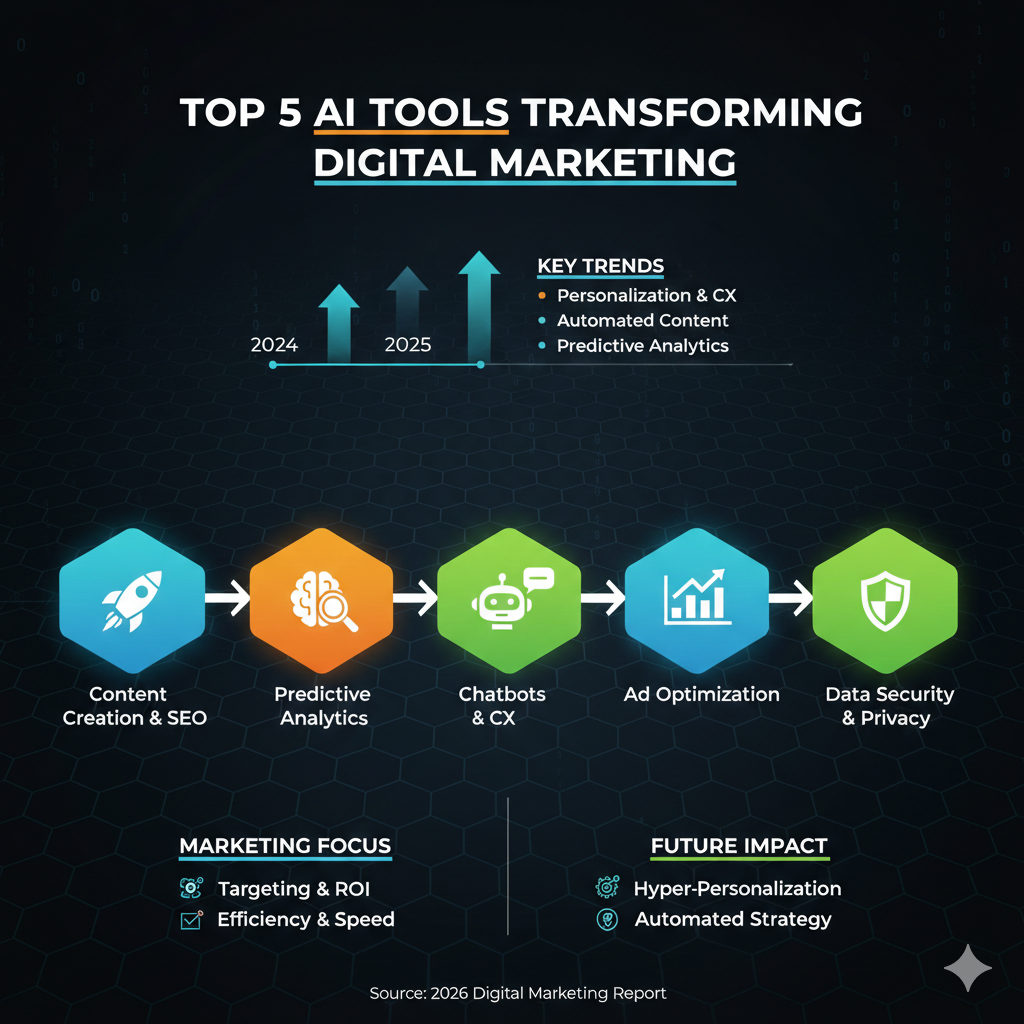
In light of the transformative potential of AI, this study focuses on the top five AI tools currently revolutionizing digital marketing practices. These tools represent the leading applications of AI in areas such as analytics, content creation, customer engagement, advertising optimization, and social media management. By examining these tools, this study aims to provide insight into how organizations can integrate AI into marketing strategies to improve efficiency, enhance personalization, and achieve measurable results. Each tool will be analyzed in terms of its functionality, practical benefits, and real-world applications, demonstrating how AI is shaping the future of digital marketing. Through this exploration, the study highlights the ways in which AI is not only transforming traditional marketing processes but also enabling organizations to deliver more meaningful, data-driven experiences to customers, strengthening competitive positioning and supporting sustainable growth.
5. AI-Powered Customer Insights and Analytics Tools
The Importance of AI in Data-Driven Decision-Making
In today’s highly competitive digital landscape, data has become one of the most critical assets for businesses seeking to enhance marketing effectiveness. However, the sheer volume and complexity of consumer data generated across digital touchpoints make it challenging for marketers to extract actionable insights using traditional analytics approaches. AI-powered customer insights and analytics tools address this challenge by applying machine learning, predictive modeling, and natural language processing to large datasets. These systems go beyond descriptive reporting, allowing marketers to not only understand past behavior but also anticipate future customer actions. By identifying patterns and correlations that are not immediately visible, AI tools enable businesses to make informed decisions that enhance targeting, resource allocation, and overall campaign performance. The result is a shift from reactive marketing strategies to proactive, intelligence-driven decision-making, empowering firms to deliver more personalized and timely customer interactions while optimizing operational efficiency.
Key Features of AI Analytics Tools
AI analytics platforms offer a range of features designed to transform raw data into actionable insights. Predictive analytics allows organizations to forecast customer behaviors such as purchase propensity, churn likelihood, and engagement patterns. By analyzing historical and real-time data, these tools generate models that help marketers anticipate trends and customer needs, enabling preemptive interventions rather than reactive solutions. Customer segmentation is another essential feature, where AI identifies groups of consumers with similar behaviors, preferences, and values. Unlike traditional demographic segmentation, AI-driven clustering is behaviorally informed, allowing marketers to target campaigns with precision and relevance. Churn prediction models estimate the probability that a customer will discontinue service, enabling retention strategies tailored to at-risk segments. These features collectively allow businesses to make decisions grounded in data-driven insights, improving efficiency and effectiveness across marketing initiatives.
Examples of Leading AI Analytics Tools
Several AI-powered platforms have emerged as leaders in customer insights and analytics. HubSpot AI consolidates data from multiple touchpoints, including email interactions, website behavior, and social media engagement, to create comprehensive customer profiles. It uses AI to score leads based on their likelihood to convert, recommend next-best actions for sales teams, and forecast customer behaviors. Salesforce Einstein, integrated within the Salesforce Customer 360 platform, automates data preparation and delivers predictive scores such as purchase probability and churn risk, helping marketers optimize personalized engagement strategies. Pega Marketing AI emphasizes real-time decisioning, analyzing customer signals as they occur to enable dynamic, context-aware offers. These tools not only generate insights but also operationalize them, allowing teams to act immediately on predictive recommendations, enhancing responsiveness and customer satisfaction.
Benefits for Marketers
The adoption of AI-powered analytics tools delivers measurable benefits for marketers. By transforming raw data into actionable insights, these platforms enable improved targeting, trend anticipation, and resource allocation. Predictive analytics allows marketing teams to identify high-value segments and prioritize campaigns for maximum impact, improving ROI. Behavioral segmentation ensures that campaigns resonate with relevant audiences, increasing engagement and conversion rates. AI-driven churn prediction helps marketers retain at-risk customers through personalized interventions, reducing attrition and protecting revenue streams. Organizations that leverage AI analytics often report ROI increases ranging from 15% to 30% in campaign effectiveness, reflecting the tangible impact of these tools on marketing efficiency and profitability. Beyond financial gains, AI-driven insights strengthen the strategic alignment of marketing efforts with broader business objectives, enabling proactive decision-making and enhanced customer experience.
Case Study: SaaS Application of AI Analytics
A mid-sized SaaS company faced declining engagement and high churn rates among its freemium users. After implementing an AI-powered customer insights platform, the company integrated usage data from its application, support tickets, and email interactions. Predictive models identified segments most likely to convert to paid subscriptions and highlighted behavioral triggers correlated with retention. Targeted in-app messages and personalized email campaigns led to a 22% increase in conversion rates within six months. Additionally, churn prediction enabled the customer success team to prioritize outreach to at-risk users, reducing churn by nearly 18%. This case demonstrates how AI analytics can provide actionable, predictive insights that directly improve operational outcomes, customer satisfaction, and revenue growth.
Case Study: E-Commerce Application
In the e-commerce sector, a global retailer used AI analytics to optimize its holiday campaigns. Machine learning models analyzed past purchase behavior, browsing patterns, and cross-channel engagement to predict products likely to appeal to specific customer segments. Using these insights, the marketing team adjusted website recommendations, email promotions, and paid advertising audiences in real time. The result was a 27% increase in average order value and a 19% boost in campaign ROI compared to the previous year. The case illustrates the value of AI-driven segmentation and predictive targeting in driving tangible performance improvements.
4. AI for Content Creation and Personalization
The integration of artificial intelligence in content creation and personalization has transformed the way businesses engage with customers. Traditional content marketing relied heavily on human creativity, extensive planning, and labor-intensive production, which often resulted in high costs, slower turnaround times, and challenges in scaling campaigns. AI-generated content leverages natural language processing, computer vision, and generative algorithms to produce text, images, video, and other multimedia content efficiently. By automating content creation, marketers can maintain a consistent brand voice across channels, rapidly adapt campaigns to emerging trends, and deliver personalized experiences to audiences at scale. AI-generated content not only addresses efficiency constraints but also provides insights into audience preferences, enabling campaigns that resonate more deeply with target segments. Businesses can now combine AI-powered content creation with predictive analytics to tailor messages, visuals, and experiences, fostering higher engagement and conversion rates while reducing operational bottlenecks.
Types of AI-Generated Content
AI tools enable the generation of diverse content types that cater to the multifaceted needs of digital marketing. Text-based content includes blog posts, articles, ad copy, social media captions, and email newsletters. Platforms such as ChatGPT, Jasper AI, and Copy.ai utilize advanced language models to generate coherent, contextually relevant, and SEO-optimized content in minutes, drastically reducing production timelines. Visual content includes AI-generated images, infographics, and video snippets. Tools such as Canva AI and Runway allow marketers to create dynamic visual assets tailored to campaign requirements without requiring specialized design skills. AI-generated video content has grown particularly impactful, with algorithms automatically editing clips, adding captions, and even generating avatars or voiceovers. By combining these modalities, brands can develop integrated campaigns that communicate a cohesive narrative across multiple platforms, ensuring that content delivery aligns with evolving consumer expectations and digital consumption patterns.
AI Tools for Content Creation
Several AI tools have emerged as leaders in content generation and personalization. ChatGPT, developed by OpenAI, excels at creating conversational text, social media captions, and article drafts, enabling teams to rapidly produce content at scale. Jasper AI is optimized for marketing copy, including website content, ad copy, and email sequences, with built-in frameworks for tone, style, and audience targeting. Copy.ai offers automated content suggestions, blog outlines, and social media posts that align with specific brand goals. For visual content, Canva AI leverages generative design capabilities to produce custom graphics, dynamic templates, and social media visuals efficiently. These tools allow marketers to combine creativity with algorithmic efficiency, reducing manual effort while maintaining brand consistency. In addition, many AI platforms incorporate real-time analytics, enabling marketers to refine generated content based on engagement metrics and audience feedback, further enhancing relevance and impact.
Content Personalization with AI
Beyond creation, AI enables advanced content personalization that significantly improves marketing effectiveness. Personalization extends across multiple touchpoints, including websites, email campaigns, and product recommendations. AI-based product recommendations analyze user behavior, preferences, and purchase history to suggest products that are most likely to resonate with individual customers, increasing conversion rates and customer satisfaction. In email marketing, AI-generated content can tailor subject lines, visuals, and messaging for each recipient, improving open rates and click-through rates. Studies indicate that AI-generated personalized emails can increase click-through rates by 14–20% compared to non-personalized campaigns. On websites and apps, AI dynamically adjusts content layouts, promotional banners, and interactive elements to match the preferences and engagement patterns of each user. This level of personalization not only enhances the customer experience but also strengthens brand loyalty and fosters long-term engagement.
Efficiency and Time Savings
A major advantage of AI content creation tools is the reduction of production time. Traditional content production often involves multiple stakeholders, including writers, designers, editors, and social media managers, which can extend timelines by several weeks. AI tools accelerate content generation by automating repetitive tasks, generating drafts instantaneously, and enabling rapid iteration based on performance metrics. Reports suggest that AI-driven content creation can reduce production time by 50–70%, allowing marketing teams to focus on strategy, creative refinement, and campaign optimization. This efficiency is particularly valuable in fast-paced industries such as e-commerce, SaaS, and consumer technology, where campaigns must respond rapidly to seasonal trends, competitor activity, and emerging consumer behavior.
Benefits for Marketers
The integration of AI in content creation and personalization delivers multiple benefits. First, AI enhances scalability, enabling marketers to produce high-quality content across multiple channels simultaneously. Second, it ensures consistency in tone, messaging, and branding, which is essential for maintaining a unified customer experience. Third, AI-driven personalization improves engagement metrics, including click-through rates, time on page, and conversion rates. Fourth, the automation of routine tasks frees human resources to focus on strategy, innovation, and creative problem-solving. Finally, the data-driven nature of AI-generated content allows continuous optimization, as algorithms learn from audience interactions to refine future campaigns. By combining speed, personalization, and analytics, AI empowers marketing teams to achieve measurable ROI improvements while maintaining high-quality content standards.
Case Study: SaaS Company Scaling Content with AI
A leading SaaS company specializing in project management solutions faced challenges in producing consistent content for its blog, social media channels, and email campaigns. With a small marketing team, the company struggled to maintain frequency and relevance, resulting in stagnating website traffic and declining engagement. By integrating Jasper AI for text content and Canva AI for visuals, the team automated 60% of its content production workflows. AI-driven predictive analytics suggested trending topics and optimal posting times for its audience segments. Within six months, blog traffic increased by 38%, social media engagement rose by 42%, and email campaign open rates improved by 17%. Personalized product recommendations within email campaigns further increased click-through rates by 15%. This case highlights how AI tools can enable a small marketing team to achieve enterprise-level output, improve customer targeting, and drive measurable performance improvements across channels.
Case Study: E-Commerce Brand Personalization
An e-commerce retailer leveraged AI-powered content personalization to improve engagement during seasonal sales events. Using Copy.ai and ChatGPT, the brand generated hundreds of customized promotional messages tailored to user browsing history and purchase behavior. Email campaigns incorporating AI-generated subject lines and product recommendations achieved a 19% increase in open rates and a 22% increase in conversion compared to previous campaigns. Additionally, dynamic visuals generated with Canva AI improved social media engagement by 28%, demonstrating that combining AI-generated content with personalized messaging delivers a synergistic effect. The approach allowed the brand to maintain a consistent voice while delivering highly relevant content to each customer, resulting in higher satisfaction and repeat purchases.
Challenges and Considerations
While AI offers significant advantages in content creation and personalization, organizations must consider several challenges. Data quality is critical, as AI-generated content relies on accurate, complete, and current datasets. Poor-quality data can lead to irrelevant or inaccurate content, harming brand perception. Over-reliance on automation may diminish creativity and originality, requiring human oversight to ensure authentic and engaging messaging. Ethical considerations and compliance with data privacy regulations are essential, particularly when personalizing content based on sensitive customer information. Companies must balance AI efficiency with human creativity and strategic judgment to achieve optimal outcomes. Additionally, integrating multiple AI tools requires technical expertise and infrastructure support to ensure seamless workflows and reliable outputs.
3. AI-Powered Chatbots and Conversational Marketing
Artificial intelligence-powered chatbots have become central to digital marketing and customer service strategies in 2026, offering businesses the ability to interact with customers in real time and at scale. Unlike traditional customer service models that rely solely on human agents, AI chatbots leverage natural language processing, machine learning, and automation to provide 24/7 support, answer queries, and guide users through various stages of the customer journey. By integrating AI-driven chatbots into websites, mobile apps, and social media platforms, organizations can deliver instantaneous responses to common inquiries, facilitate product recommendations, and enhance engagement without incurring the cost of round-the-clock human support. This technology also supports conversational marketing, which emphasizes personalized, interactive dialogues with customers rather than one-way communication. Through chatbots, businesses can capture leads, qualify prospects, and nurture relationships efficiently, thereby improving operational efficiency, customer satisfaction, and overall revenue performance.
Evolution of Conversational Marketing
Conversational marketing has evolved from simple automated scripts and FAQ systems to highly intelligent AI-driven chat interfaces capable of nuanced human-like interactions. Early chatbots were limited to pre-programmed responses and could handle only a narrow range of customer queries. In contrast, modern AI chatbots such as Drift, Intercom, ManyChat, and LivePerson employ sophisticated algorithms that understand context, sentiment, and intent, enabling more meaningful and accurate interactions. Conversational marketing goes beyond answering questions; it creates personalized experiences by recommending products, scheduling appointments, and providing real-time support. For instance, AI chatbots can analyze user behavior and previous interactions to suggest the most relevant services or products, making the experience seamless and tailored to individual needs. This transition from reactive customer support to proactive engagement has transformed how companies approach lead generation, customer retention, and overall brand perception in increasingly competitive digital markets.
Key Features of AI Chatbots
AI chatbots incorporate multiple features that enhance both operational efficiency and customer experience. 24/7 support ensures that customers receive assistance at any time, eliminating delays caused by traditional business hours. Automated lead qualification allows chatbots to ask targeted questions, identify high-value prospects, and route them to appropriate sales teams, improving the efficiency of conversion pipelines. Conversational commerce enables customers to browse, select, and purchase products directly through chat interfaces, creating a seamless shopping experience that reduces friction and accelerates sales cycles. Advanced AI models also incorporate natural language understanding to process complex queries and multi-turn conversations, ensuring responses are contextually relevant and accurate. By integrating chatbots with CRM systems and marketing automation platforms, organizations can maintain detailed records of interactions, providing insights for personalization and continuous improvement.
Benefits of AI Chatbots for Marketers
The adoption of AI chatbots offers numerous advantages for marketing and customer service teams. First, they improve response times, often resolving queries in seconds, which enhances customer satisfaction and loyalty. Studies indicate that 69% of consumers prefer chatbots for simple inquiries due to their speed and accessibility. Second, AI chatbots increase lead capture, with many organizations reporting a 20–35% rise in qualified leads after implementing automated conversational tools. Third, chatbots facilitate better customer retention by maintaining consistent engagement, reducing churn, and offering personalized recommendations that strengthen the customer relationship. Fourth, chatbots provide scalability, allowing companies to manage large volumes of inquiries simultaneously without hiring additional staff, which reduces operational costs. Finally, AI chatbots support data-driven decision-making by analyzing interactions to identify patterns, preferences, and common pain points, informing marketing strategies and product development.
Case Study: SaaS Company Scaling Support with Chatbots
A leading SaaS company providing cloud-based project management solutions faced growing support demands as its user base expanded globally. Customer inquiries, feature requests, and troubleshooting tickets overwhelmed a small support team, resulting in long response times and lower customer satisfaction scores. To address these challenges, the company implemented Drift and Intercom chatbots, integrating them across its website, mobile application, and support portal. The AI chatbots were trained to handle over 70% of support inquiries, including password resets, feature explanations, billing questions, and basic troubleshooting steps. Within six months, the average response time decreased from 12 hours to under 2 minutes, customer satisfaction ratings increased by 25%, and first-contact resolution improved by 30%. Additionally, automated lead qualification through chat interactions led to a 22% increase in sales-qualified leads, demonstrating that AI chatbots not only enhance support efficiency but also contribute directly to business growth.
Case Study: E-Commerce Brand Improving Conversational Marketing
An international e-commerce retailer adopted ManyChat and LivePerson chatbots to engage customers on social media and its online store. By leveraging AI-powered conversational flows, the brand automated order tracking, product recommendations, and promotional notifications. The system dynamically adapted messages based on user behavior, purchase history, and engagement patterns. The results were significant: 68% of customers interacted with chatbots for inquiries, 24% of chatbot interactions resulted in completed purchases, and repeat purchase rates increased by 15% over six months. The personalized conversational experience enhanced customer satisfaction while allowing the company to scale marketing operations without proportional increases in staff. This case highlights how AI chatbots enable businesses to deliver seamless, interactive experiences that drive both engagement and conversion.
AI Chatbots and Operational Efficiency
AI chatbots provide measurable improvements in operational efficiency. By handling repetitive tasks such as answering common questions, scheduling appointments, and processing basic transactions, chatbots free human agents to focus on complex, high-value interactions. This leads to improved agent productivity, reduced error rates, and optimized resource allocation. Furthermore, chatbots can handle thousands of concurrent interactions without delays, which is critical during peak traffic periods such as product launches or promotional campaigns. Integration with analytics platforms allows companies to monitor trends, identify recurring issues, and continuously improve automated scripts. This combination of efficiency and intelligence enables organizations to maintain high service standards while minimizing operational costs, providing a competitive advantage in digital marketplaces where responsiveness and speed are highly valued.
Customer Experience and Engagement
AI-powered chatbots significantly enhance the customer experience by providing immediate, relevant, and personalized interactions. Customers no longer need to wait for human agents or navigate complex menus, as chatbots can guide them through inquiries with intuitive conversational flows. Sentiment analysis allows chatbots to detect frustration or dissatisfaction, escalating high-priority issues to human agents when necessary. Additionally, chatbots can deliver proactive messages, such as alerts about promotions, abandoned carts, or service updates, which keeps customers engaged and reduces attrition. Research indicates that 57% of customers are more likely to engage with a brand that offers chatbot support, and businesses using chatbots experience up to a 35% increase in engagement rates. By combining personalization, automation, and real-time responsiveness, AI chatbots redefine how brands connect with customers in an increasingly digital-first world.
Conversational Commerce and Sales Optimization
Beyond support, AI chatbots play a crucial role in conversational commerce, where interactions directly drive sales. Chatbots can guide users through product catalogs, compare options, answer technical questions, and facilitate secure checkout processes within the chat interface. Automated upselling and cross-selling recommendations further boost average order value. For instance, chatbots can suggest complementary products based on previous purchases or browsing history, creating a personalized shopping experience that mirrors human recommendations. Companies have reported conversion rate increases of 20–25% when using AI chatbots for conversational commerce, demonstrating the direct impact of these tools on revenue generation. By combining personalized engagement with real-time transaction capabilities, chatbots bridge the gap between marketing, sales, and customer service.
Challenges and Considerations
Despite the benefits, implementing AI chatbots requires careful planning. Data privacy and compliance are paramount, as chatbots process sensitive customer information, including personal details, payment information, and behavioral data. Inaccurate responses or poorly trained chatbots can negatively affect brand reputation and trust. Organizations must also maintain a balance between automation and human interaction, ensuring that complex issues are escalated to qualified agents. Continuous monitoring, training, and updates are necessary to improve chatbot accuracy and relevance. Additionally, businesses need to consider cultural nuances and language diversity when deploying global chatbot solutions, as interactions must feel natural and contextually appropriate to maintain a high-quality user experience.
2. AI in Paid Advertising and Programmatic Marketing
Artificial intelligence has fundamentally transformed paid advertising and programmatic marketing, offering marketers unprecedented precision, efficiency, and scalability in reaching target audiences. Programmatic advertising leverages AI and machine learning algorithms to automate the process of buying, placing, and optimizing digital ads across multiple platforms in real time. Unlike traditional advertising methods, which rely on manual bidding, ad placements, and demographic assumptions, AI-powered programmatic systems analyze vast amounts of user data to predict the most relevant audiences and the optimal timing for ad delivery. By continuously processing behavioral, contextual, and transactional data, these systems ensure that advertisements are shown to users who are most likely to engage or convert, thereby improving campaign performance and reducing wasted spend. AI’s ability to integrate predictive analytics, real-time optimization, and dynamic targeting makes programmatic marketing a highly strategic tool for organizations seeking to maximize ROI and maintain a competitive advantage in the fast-paced digital ecosystem.
Programmatic Advertising and Its Evolution
Programmatic advertising has evolved from basic automated display networks to sophisticated AI-driven platforms capable of multi-channel orchestration. Early programmatic systems were limited to automated ad placements based on demographic data, leading to inefficiencies and irrelevant impressions. Modern AI-powered tools, such as Google Ads AI, Adobe Sensei, and Albert AI, incorporate advanced machine learning models to analyze user intent, engagement patterns, and contextual relevance in real time. These systems not only optimize ad delivery for clicks and impressions but also predict user actions, enabling marketers to refine creative messaging and adjust budgets dynamically. Programmatic marketing now spans display, social media, search, and video ads, integrating cross-platform analytics to provide a holistic view of campaign effectiveness. This evolution allows brands to deliver hyper-personalized advertising at scale, increasing relevance, engagement, and conversion rates while simultaneously reducing manual oversight and operational complexity.
Key Features of AI-Powered Programmatic Advertising
AI-powered programmatic advertising platforms offer a range of features that enhance targeting, efficiency, and campaign performance. Automated bidding allows algorithms to determine the optimal bid for each impression in real time, maximizing the likelihood of engagement or conversion while minimizing costs. Real-time audience targeting uses predictive analytics to identify high-value users based on browsing behavior, search history, demographic attributes, and previous interactions. Platforms can segment audiences dynamically, adjusting targeting criteria as new data becomes available. Ad performance optimization leverages AI to continuously test and adapt creative content, placement, and messaging, ensuring that campaigns achieve their objectives efficiently. Additionally, AI systems can perform budget allocation and frequency capping, ensuring that advertising spend is optimized across channels and that audiences are not oversaturated. Collectively, these features enable marketers to achieve higher click-through rates, lower cost-per-click, and better overall campaign ROI.
Benefits of AI in Paid Advertising
The adoption of AI-powered programmatic advertising provides numerous advantages for marketers and organizations. First, AI enhances campaign precision, ensuring that ads reach the most relevant audiences based on predicted intent and engagement likelihood. This reduces wasted impressions and improves overall efficiency. Second, AI contributes to higher CTR and conversion rates, as campaigns are continuously optimized in real time to present the right message to the right audience at the right time. Third, automated bidding and budget optimization allow marketers to lower cost-per-click and maximize return on ad spend, making campaigns more cost-effective than traditional manual approaches. Fourth, AI-driven analytics provide actionable insights into consumer behavior, preferences, and engagement patterns, supporting informed decision-making for future campaigns. Studies indicate that AI-powered campaigns can outperform traditional campaigns by 20–30% in terms of CTR and ROI, highlighting the tangible business value of AI integration in programmatic marketing. Finally, AI enables scalability, allowing businesses to manage complex campaigns across multiple channels without proportional increases in human resources.
Case Study: Scaling ROI with AI Ad Optimization
A global SaaS company providing cloud-based productivity tools faced challenges in reaching qualified prospects efficiently through traditional paid advertising channels. Manual ad placement and bidding were time-consuming, costly, and yielded inconsistent results. The company implemented Albert AI, an autonomous AI marketing platform, to manage search, social, and display campaigns simultaneously. The platform analyzed millions of data points, including user behavior, past engagement, and competitive ad activity, to dynamically optimize targeting, creative content, and bid strategies. Within six months, the company reported a 28% increase in CTR, a 15% reduction in CPC, and a 32% increase in overall ROI from digital ad spend. Additionally, AI-driven insights revealed previously untapped audience segments, enabling the marketing team to refine messaging and develop highly targeted campaigns. By automating optimization, the company reduced manual labor by 40%, allowing the team to focus on strategy, creative design, and campaign expansion. This case demonstrates the potential for AI-powered programmatic advertising to transform digital marketing efficiency, precision, and profitability.
Case Study: E-Commerce Brand Optimizing Customer Acquisition
An international e-commerce retailer sought to enhance customer acquisition and reduce advertising costs across multiple digital channels. By adopting Google Ads AI for programmatic campaigns, the company leveraged automated bidding and predictive targeting to deliver personalized ads to users most likely to convert. The AI system continuously monitored user engagement metrics, website activity, and purchase intent signals to optimize ad placement and creative messaging. Over a six-month period, the brand achieved a 35% increase in conversions, a 20% decrease in cost-per-acquisition, and a 27% higher return on ad spend compared to manually managed campaigns. Furthermore, AI-driven audience segmentation enabled the retailer to target specific demographics with tailored messaging, increasing relevance and brand resonance. This case highlights how AI programmatic advertising not only drives measurable financial benefits but also improves customer experience by delivering more personalized and timely communications.
Operational Efficiency and Marketing Effectiveness
AI-powered programmatic advertising also significantly enhances operational efficiency for marketing teams. By automating routine tasks such as bid adjustments, audience targeting, and performance reporting, AI allows marketers to allocate more time to strategic planning, creative development, and campaign innovation. Real-time optimization ensures that campaigns adapt continuously to changing market conditions, competitor activity, and user behavior, preventing wasted spend and maximizing impact. Integration with CRM and analytics platforms provides a unified view of marketing performance across channels, allowing marketers to make data-driven decisions quickly and effectively. Operational improvements not only increase efficiency but also reduce human error, improve campaign consistency, and facilitate rapid scaling of digital marketing efforts.
Data-Driven Insights and Predictive Analytics
A critical component of AI-powered programmatic advertising is its ability to generate actionable insights through predictive analytics. By analyzing historical campaign data, user behavior, and contextual signals, AI platforms can forecast engagement likelihood, conversion probability, and optimal budget allocation. These insights inform both strategic and tactical decisions, such as which creative content resonates best with specific audiences, which channels deliver the highest ROI, and which timeframes maximize engagement. Predictive analytics also enable marketers to anticipate trends, adjust campaigns proactively, and refine targeting for higher performance. This data-driven approach allows businesses to optimize campaigns continuously rather than relying on static assumptions, resulting in more effective and efficient advertising outcomes.
1. AI in Paid Advertising and Programmatic Marketing
Artificial intelligence has fundamentally transformed paid advertising and programmatic marketing, offering marketers unprecedented precision, efficiency, and scalability in reaching target audiences. Programmatic advertising leverages AI and machine learning algorithms to automate the process of buying, placing, and optimizing digital ads across multiple platforms in real time. Unlike traditional advertising methods, which rely on manual bidding, ad placements, and demographic assumptions, AI-powered programmatic systems analyze vast amounts of user data to predict the most relevant audiences and the optimal timing for ad delivery. By continuously processing behavioral, contextual, and transactional data, these systems ensure that advertisements are shown to users who are most likely to engage or convert, thereby improving campaign performance and reducing wasted spend. AI’s ability to integrate predictive analytics, real-time optimization, and dynamic targeting makes programmatic marketing a highly strategic tool for organizations seeking to maximize ROI and maintain a competitive advantage in the fast-paced digital ecosystem.
Programmatic Advertising and Its Evolution
Programmatic advertising has evolved from basic automated display networks to sophisticated AI-driven platforms capable of multi-channel orchestration. Early programmatic systems were limited to automated ad placements based on demographic data, leading to inefficiencies and irrelevant impressions. Modern AI-powered tools, such as Google Ads AI, Adobe Sensei, and Albert AI, incorporate advanced machine learning models to analyze user intent, engagement patterns, and contextual relevance in real time. These systems not only optimize ad delivery for clicks and impressions but also predict user actions, enabling marketers to refine creative messaging and adjust budgets dynamically. Programmatic marketing now spans display, social media, search, and video ads, integrating cross-platform analytics to provide a holistic view of campaign effectiveness. This evolution allows brands to deliver hyper-personalized advertising at scale, increasing relevance, engagement, and conversion rates while simultaneously reducing manual oversight and operational complexity.
Key Features of AI-Powered Programmatic Advertising
AI-powered programmatic advertising platforms offer a range of features that enhance targeting, efficiency, and campaign performance. Automated bidding allows algorithms to determine the optimal bid for each impression in real time, maximizing the likelihood of engagement or conversion while minimizing costs. Real-time audience targeting uses predictive analytics to identify high-value users based on browsing behavior, search history, demographic attributes, and previous interactions. Platforms can segment audiences dynamically, adjusting targeting criteria as new data becomes available. Ad performance optimization leverages AI to continuously test and adapt creative content, placement, and messaging, ensuring that campaigns achieve their objectives efficiently. Additionally, AI systems can perform budget allocation and frequency capping, ensuring that advertising spend is optimized across channels and that audiences are not oversaturated. Collectively, these features enable marketers to achieve higher click-through rates, lower cost-per-click, and better overall campaign ROI.
Benefits of AI in Paid Advertising
The adoption of AI-powered programmatic advertising provides numerous advantages for marketers and organizations. First, AI enhances campaign precision, ensuring that ads reach the most relevant audiences based on predicted intent and engagement likelihood. This reduces wasted impressions and improves overall efficiency. Second, AI contributes to higher CTR and conversion rates, as campaigns are continuously optimized in real time to present the right message to the right audience at the right time. Third, automated bidding and budget optimization allow marketers to lower cost-per-click and maximize return on ad spend, making campaigns more cost-effective than traditional manual approaches. Fourth, AI-driven analytics provide actionable insights into consumer behavior, preferences, and engagement patterns, supporting informed decision-making for future campaigns. Studies indicate that AI-powered campaigns can outperform traditional campaigns by 20–30% in terms of CTR and ROI, highlighting the tangible business value of AI integration in programmatic marketing. Finally, AI enables scalability, allowing businesses to manage complex campaigns across multiple channels without proportional increases in human resources.
Case Study: Scaling ROI with AI Ad Optimization
A global SaaS company providing cloud-based productivity tools faced challenges in reaching qualified prospects efficiently through traditional paid advertising channels. Manual ad placement and bidding were time-consuming, costly, and yielded inconsistent results. The company implemented Albert AI, an autonomous AI marketing platform, to manage search, social, and display campaigns simultaneously. The platform analyzed millions of data points, including user behavior, past engagement, and competitive ad activity, to dynamically optimize targeting, creative content, and bid strategies. Within six months, the company reported a 28% increase in CTR, a 15% reduction in CPC, and a 32% increase in overall ROI from digital ad spend. Additionally, AI-driven insights revealed previously untapped audience segments, enabling the marketing team to refine messaging and develop highly targeted campaigns. By automating optimization, the company reduced manual labor by 40%, allowing the team to focus on strategy, creative design, and campaign expansion. This case demonstrates the potential for AI-powered programmatic advertising to transform digital marketing efficiency, precision, and profitability.
Case Study: E-Commerce Brand Optimizing Customer Acquisition
An international e-commerce retailer sought to enhance customer acquisition and reduce advertising costs across multiple digital channels. By adopting Google Ads AI for programmatic campaigns, the company leveraged automated bidding and predictive targeting to deliver personalized ads to users most likely to convert. The AI system continuously monitored user engagement metrics, website activity, and purchase intent signals to optimize ad placement and creative messaging. Over a six-month period, the brand achieved a 35% increase in conversions, a 20% decrease in cost-per-acquisition, and a 27% higher return on ad spend compared to manually managed campaigns. Furthermore, AI-driven audience segmentation enabled the retailer to target specific demographics with tailored messaging, increasing relevance and brand resonance. This case highlights how AI programmatic advertising not only drives measurable financial benefits but also improves customer experience by delivering more personalized and timely communications.
Operational Efficiency and Marketing Effectiveness
AI-powered programmatic advertising also significantly enhances operational efficiency for marketing teams. By automating routine tasks such as bid adjustments, audience targeting, and performance reporting, AI allows marketers to allocate more time to strategic planning, creative development, and campaign innovation. Real-time optimization ensures that campaigns adapt continuously to changing market conditions, competitor activity, and user behavior, preventing wasted spend and maximizing impact. Integration with CRM and analytics platforms provides a unified view of marketing performance across channels, allowing marketers to make data-driven decisions quickly and effectively. Operational improvements not only increase efficiency but also reduce human error, improve campaign consistency, and facilitate rapid scaling of digital marketing efforts.
Data-Driven Insights and Predictive Analytics
A critical component of AI-powered programmatic advertising is its ability to generate actionable insights through predictive analytics. By analyzing historical campaign data, user behavior, and contextual signals, AI platforms can forecast engagement likelihood, conversion probability, and optimal budget allocation. These insights inform both strategic and tactical decisions, such as which creative content resonates best with specific audiences, which channels deliver the highest ROI, and which timeframes maximize engagement. Predictive analytics also enable marketers to anticipate trends, adjust campaigns proactively, and refine targeting for higher performance. This data-driven approach allows businesses to optimize campaigns continuously rather than relying on static assumptions, resulting in more effective and efficient advertising outcomes.
Challenges and Considerations
Despite its advantages, AI-powered programmatic advertising presents several challenges. Data privacy and compliance are critical, as AI systems rely on large volumes of personal and behavioral data to optimize campaigns. Companies must ensure adherence to regulations such as GDPR and CCPA while maintaining trust with their audiences. Additionally, AI systems require continuous monitoring and calibration to prevent errors in targeting, bid allocation, or creative optimization. Poorly trained models or incomplete datasets can lead to wasted ad spend and suboptimal performance. Marketers must also consider the risk of over-reliance on automation, ensuring that human oversight complements AI decision-making, particularly for brand-sensitive messaging and strategic planning. Finally, integrating AI platforms with existing marketing technology stacks can be complex, requiring proper training, resources, and cross-functional collaboration.
Conclusion
Artificial intelligence is no longer a futuristic concept in digital marketing; it has become an essential driver of efficiency, personalization, and measurable business impact. Across industries, AI is transforming how marketers understand customer behavior, create and distribute content, optimize campaigns, and deliver seamless experiences. By analyzing vast amounts of data in real time, AI enables businesses to make informed decisions, predict trends, and respond proactively to changing consumer preferences. Its integration into marketing workflows allows organizations to move beyond traditional trial-and-error approaches, replacing them with precision, scalability, and actionable insights that improve return on investment and competitive positioning.
The Top 5 AI tools highlighted in this article illustrate the diverse ways AI is reshaping digital marketing. AI-powered analytics platforms like HubSpot AI and Salesforce Einstein offer predictive insights, audience segmentation, and churn analysis, allowing marketers to understand customers better and make data-driven decisions. Content creation tools such as ChatGPT, Jasper AI, and Canva AI streamline the production of text, images, and videos while enabling personalized messaging that resonates with specific audiences. AI chatbots, including Drift and Intercom, enhance customer experience by providing 24/7 support, qualifying leads, and facilitating conversational commerce. Programmatic advertising tools like Albert AI and Google Ads AI automate bidding, optimize targeting, and improve campaign performance, ensuring higher engagement at lower cost. AI-enabled social media and influencer management platforms help brands maintain consistent engagement, track sentiment, and scale campaigns across multiple channels. Together, these tools demonstrate that AI is not just a support function but a transformative force in modern marketing strategies.
Looking ahead, AI is set to continue shaping digital marketing between 2026 and 2030. Emerging trends such as hyper-personalization, AI-driven omnichannel campaign orchestration, real-time optimization, and generative AI content creation will redefine customer engagement standards. Businesses that adopt AI strategically will be able to anticipate consumer needs, deliver highly relevant experiences, and maximize efficiency across operations. Conversely, companies that delay AI adoption risk falling behind in customer engagement, campaign effectiveness, and overall market competitiveness.
For marketers and business leaders, the key takeaway is clear: AI should be integrated thoughtfully into core marketing strategies rather than treated as an optional tool. Leveraging AI to its full potential can lead to higher customer satisfaction, stronger brand loyalty, improved operational efficiency, and measurable ROI. As digital marketing becomes increasingly complex, AI will continue to be the differentiator between companies that lead the market and those that struggle to keep pace. The strategic use of AI is not just an advantage—it is rapidly becoming a requirement for any organization aiming to thrive in a data-driven, customer-centric marketplace.